AI Search
AI Search in China: What B2B Companies Need to Know in 2026
September 15, 2026 · Mikael Lindblom
Generative AI research is now mainstream behaviour among Chinese professionals, and the platforms carrying it are entirely separate from the ones your global strategy is built around.
1. The scale: 602 million AI users, none of them reachable through Google
The China Internet Network Information Center reported 602 million generative AI users in China as of December 2025, up 141.7% in a year, reaching 42.8% of the population. QuestMobile, which tracks app usage, put monthly active users of AI-native apps at 499 million as of May 2026, growing 85.4% year on year. Add the AI assistants preinstalled on Chinese handsets and the total passes 755 million.
Gemini, Claude and ChatGPT are inaccessible from mainland China without a VPN. The tools most people in China use, professionals included, are Doubao, DeepSeek, Baidu ERNIE, Qwen and Kimi.
For what buyers do inside those tools, the best global read is Forrester's 2026 Buyers' Journey Survey of close to 18,000 business buyers: 94% used AI somewhere in their most recent purchase, more than half used it to compare vendors, and 47% used it to build an internal business case before contacting any vendor. Chinese buyers are doing the same work on a different set of platforms.
2. For B2B, DeepSeek and Baidu ERNIE do most of the work
If you only have budget to be visible in two places, make them DeepSeek and Baidu ERNIE. DeepSeek is where technical evaluation happens and ERNIE is where traditional search behaviour now ends up.
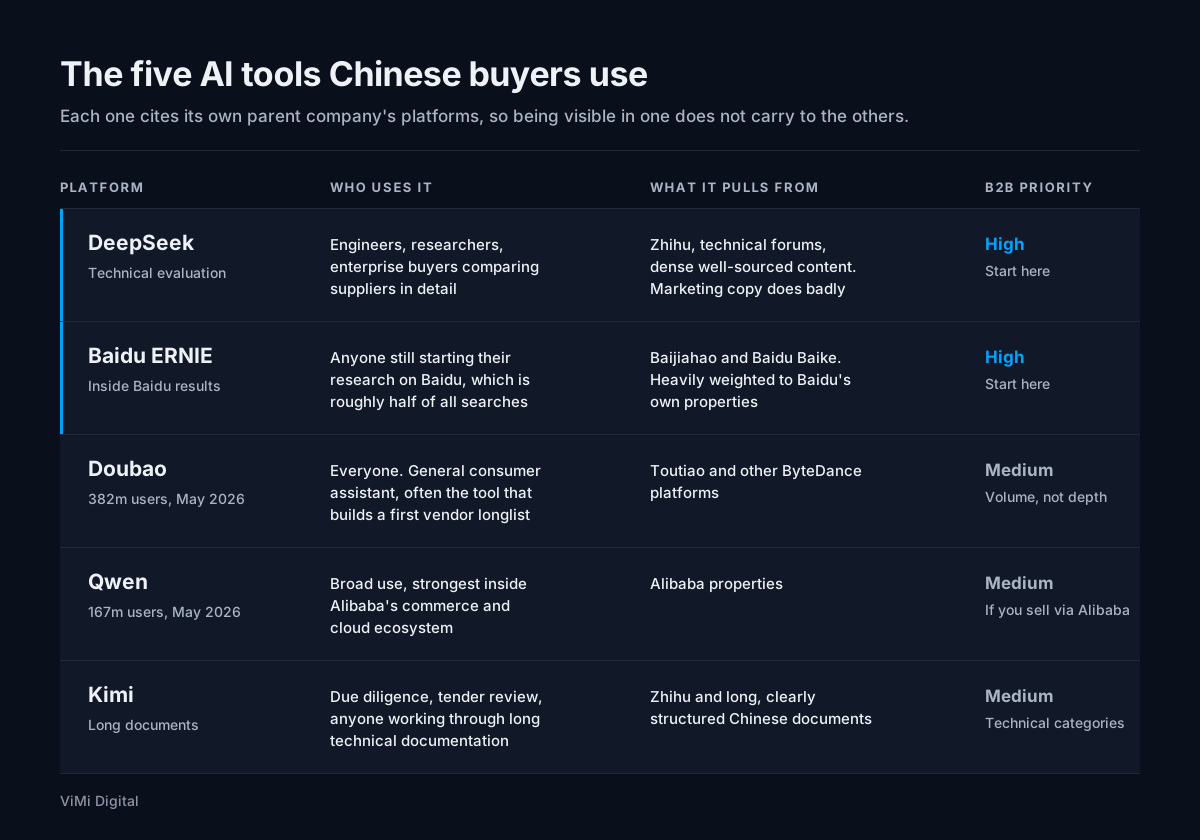
DeepSeek skews toward engineers, researchers and enterprise buyers doing detailed comparison work. This is the platform a Chinese buyer uses to check a technical claim or compare specifications across suppliers. Promotional content does not surface well here. Dense, specific, well-sourced material does, which means your Chinese technical documentation matters more than your Chinese brand messaging.
Baidu ERNIE answers appear inside Baidu search results, which puts them in front of everyone still starting their research on Baidu. ERNIE draws heavily on Baidu's own properties, so visibility here comes down to what you publish on Baijiahao, Baidu's publishing platform, and whether you have an entry in Baidu Baike, the Chinese encyclopedia.
The other three are worth understanding, though they are lower priority for most B2B categories.
Doubao, from ByteDance, is the volume leader. It passed ERNIE Bot as China's most-used AI assistant in early 2026 and QuestMobile recorded 382 million monthly active users by May 2026. It is a general consumer assistant, which matters for B2B mainly because it is the default tool for the junior staff who often assemble a first vendor longlist. Doubao answers draw mostly on ByteDance's own platforms, so the practical route to visibility is publishing on Toutiao, ByteDance's news and content platform.
Qwen, from Alibaba, sits second on most counts at 167 million monthly active users in May 2026. Prioritise it if you sell into anything connected to Alibaba's commerce or cloud ecosystem.
Kimi, from Moonshot AI, is built around a very large context window and is the common choice for document-heavy work such as due diligence and tender review. If you have long, well-structured Chinese technical documents, Kimi will use them.
Rankings between these platforms shift every few months depending on who is measuring, so treat any single user figure as an indication. What does not shift is that China has no equivalent of ChatGPT's dominance, so visibility has to be built in several places at once.
3. Your English website does not register, however well it ranks globally
Chinese AI models retrieve from Chinese-language content hosted on Chinese platforms. A company with strong global rankings and no Chinese platform presence will generally not appear as a source in a Chinese AI answer at all.
Three things have to be fixed, and the first one has the longest lead time.
Hosting and ICP filing. If you want your Chinese site to load properly for people in China, it has to sit on mainland servers, and anything on a mainland server needs an ICP filing (ICP备案). This is where most foreign companies get stuck, because you cannot apply for one as a foreign company. The filing has to be made by a Chinese legal entity. In practice that means setting up a WFOE or a joint venture, using a registered branch or representative office if you already have one, or working with a licensed local partner who files on your behalf. The hosting also has to be with an approved mainland provider like Alibaba Cloud, Tencent Cloud or Huawei Cloud, and the domain has to be registered with a Chinese registrar under the exact legal name of that entity.
On timing, if you already have a company registered in China the filing takes about two to four weeks. If you are starting from nothing, plan for three to six months, because registering the entity is the slow part rather than the filing itself. Start this before you write any content. Otherwise you pay for a Chinese site that sits finished for months while the entity registration goes through.
If none of that is realistic, Hong Kong hosting is the normal fallback. Hong Kong sits outside the mainland system, so you do not need an ICP filing. You also cannot get one, since the filing only exists for sites hosted on mainland servers. The site will load reasonably well for mainland visitors, much better than hosting in Europe or the US, but there will be no ICP number in your footer. That costs you in two places. Chinese buyers do look for that number as a sign that the company is properly set up, and SEO teams working in China consistently report that Baidu treats ICP-filed domains as more trustworthy sources.
Translation. Translating your English site into Chinese is not the same thing as having a Chinese site. Machine translation is obvious to Chinese readers and performs badly in both Chinese search and AI retrieval. Even a good human translation has a deeper problem, which is that it answers English questions in Chinese. Chinese B2B buyers ask different things, use different words for the same product category, and worry about different risks. Start from a list of the questions your Chinese buyers actually ask, then write in simplified Chinese from there.
Your own site is not enough on its own. Even a well-built Chinese site only tells a model what you say about yourself. These models weight sources they trust, and your own domain is not one of them. Before you get cited in an answer, they need to see your company mentioned somewhere you do not control, which is what the next section is about.
4. Zhihu and Baidu Baike do the job that G2 and Wikipedia do at home
Ask an AI tool in the West about a software category and it leans on G2 reviews, Reddit threads (used to at least), Wikipedia and mentions in places like Forbes or TechCrunch. Those sources decide who gets mentioned. In China none of them count. Chinese models are not trained on them and do not retrieve from them, so the review count you spent three years building and the press coverage you were pleased with do nothing for you the moment a buyer asks the same question in Chinese. You have to build that credibility again on a different set of platforms.
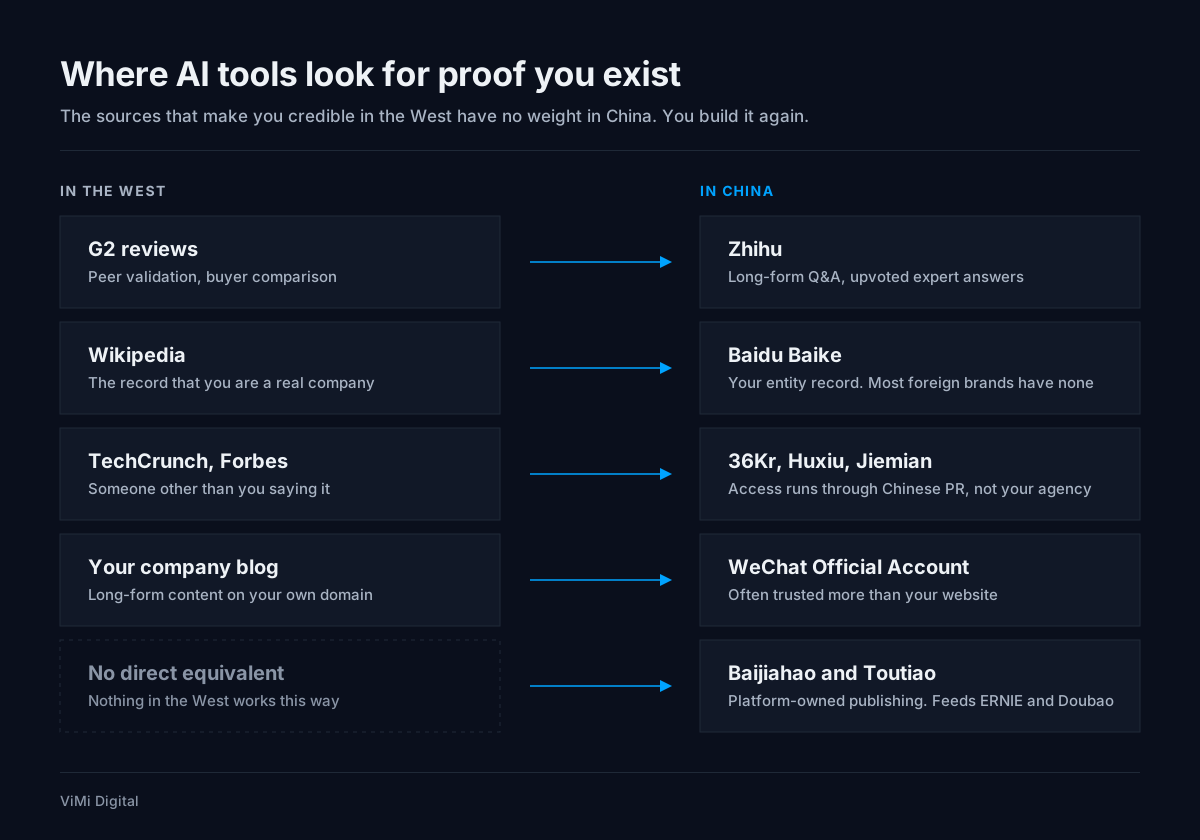
Zhihu is a long-form question and answer platform and the closest thing China has to a B2B expertise layer. Highly upvoted answers get treated as expert testimony, particularly by DeepSeek and Kimi. A meaningful share of what a Chinese model says when comparing suppliers in a category traces back to Zhihu threads.
Baidu Baike is the dominant encyclopedia and functions as your entity record. No Baike entry means no authoritative record that your company exists, which is where most foreign B2B brands sit today.
Baijiahao is Baidu's own publishing platform and feeds Baidu's AI answers directly. Toutiao does the same job inside ByteDance, feeding Doubao.
WeChat Official Accounts are where most Chinese B2B companies publish their long-form content, and those articles get picked up and used by Chinese AI tools. The account also does a second job. When a Chinese buyer wants to know whether you are a real company, an Official Account with two years of posts behind it often tells them more than your website does.
Chinese tech and business media. 36Kr, Huxiu and Jiemian cover B2B and industrial categories in depth, and because Chinese models retrieve from Chinese-language sources, coverage in them puts your company in front of the models in a way your own site cannot. This is the same logic as getting written up in TechCrunch for Western AI visibility. Different publications, and the access runs through Chinese PR contacts rather than your global agency.
Worth knowing: each of these tools mostly cites content from its own parent company's platforms. Doubao leans on ByteDance properties like Toutiao, ERNIE leans on Baijiahao and Baike, while DeepSeek and Kimi pull more from Zhihu and technical forums. That means publishing in one ecosystem does not get you visibility in the others. If you do Baijiahao properly and nothing else, you show up in Baidu's answers and stay invisible in DeepSeek.
5. Ranking on Baidu will not get you cited by DeepSeek
Ranking and getting cited are coming apart everywhere. Ahrefs found 76% of Google AI Overview citations came from top-10 pages in July 2025, and when they reran the study in March 2026 that had fallen to 38%. In China the two were never closely connected to begin with, because DeepSeek and Kimi are not reading Baidu's index at all.
Baidu SEO is still worth doing. Baidu handles roughly half of all searches in China, and its index feeds ERNIE, so one piece of work covers both. Its share has been falling for years and Bing has taken a real chunk of it, so this is not the long-term bet it was in 2020, but it is still where most search traffic sits today.
The work itself will look familiar. Host in mainland China or Hong Kong, check that Baiduspider can actually crawl the site, write in simplified Chinese, and do the keyword research in Chinese instead of translating your English list.
None of that gets you into DeepSeek or Kimi, though. Those models are not looking at Baidu's rankings. They pull from sources they trust and from what they picked up in training, so you can sit at the top of Baidu for a commercial keyword and still never show up in an AI answer.
It works the other way too. Plenty of companies get mentioned in DeepSeek without ranking on Baidu at all, because what they published ended up in Zhihu answers or in Chinese tech coverage.
6. What to do, and in what order
Work in this sequence, because each stage depends on the one before it.
Start the paperwork first. Get the Chinese entity and the ICP filing moving before anything else, because that is the three to six month item if you are starting from scratch. While that runs, register the Chinese domain and get hosting set up with an approved mainland provider. Get your Baidu Baike entry created too, since that is the record everything else points back to.
Then get on the platforms. Set up a verified WeChat Official Account and publish real long-form content on it, not like your English blog posts run through a translator. Add Baijiahao if you want to show up in Baidu and ERNIE, and Toutiao if Doubao matters in your category. Start answering questions on Zhihu properly, with actual expertise, because Zhihu readers can smell a sales pitch and so can the models trained on what those readers upvote.
Then write content the models can use. What works here is close to what a technical buyer wants anyway, which is clear headings, real numbers instead of adjectives, and the answer near the top of the page rather than four paragraphs down. Comparison content helps too, as long as you mention competitors honestly, since comparing options is one of the most common things people ask these tools to do. Keep publishing regularly, because Chinese AI engines refresh what they retrieve and newer content gets picked up more often.
Then check whether any of it worked. You cannot track this the way you track organic traffic, because the referrer data from Chinese AI tools is patchy and often stripped out completely. What works instead is testing by hand. Write out twenty to thirty questions in Chinese that a real buyer would ask, covering your category, your competitors and your own company by name. Run them through DeepSeek, Doubao, ERNIE and Kimi once a month and note how often you come up, what the models say about you, and which sources they cite. It takes about an hour.
7. How we work on this at ViMi Digital
ViMi Digital have an experienced digital marketing team on the ground in China who have seen it all: the period when Baidu SEO mattered most, the shift to WeChat, and now the shift to AI search. The same pattern repeats each time, where companies assume the global approach will carry over, spend a year finding that it does not, and then have to start building local platform presence from scratch.
At ViMi Digital we work with companies growing in China and AI visibility is getting increasingly important. We cover the technical foundation, presence on the platforms Chinese models actually cite, and content written for Chinese buyers rather than translated for them. Before we start we will do a thorough AI Visibility check tailored to you.
About the author. Mikael Lindblom is the Co-Founder of ViMi Digital, where he works with B2B teams across Asia and the Gulf on AI visibility, signal engineering and demand generation. He spent eleven years building a business in China before moving to Singapore.